78 degrees north. Polar bears outnumber people. And every season, it reveals something the human eye should not be allowed to witness — and will never forget.
There is a moment, somewhere in the middle of the Svalbard archipelago, when you realise that you are in a place that the modern world has not yet managed to domesticate. The landscape is on a scale that defies proportion — glaciers the size of small countries calving into fjords of absolute stillness, tundra plains stretching to horizons uninterrupted by any human structure, walrus colonies draped across rocky shores in arrangements that look more like geological formations than living animals.
And the polar bears. Always, eventually, the polar bears.
Svalbard — the Norwegian Arctic archipelago located midway between mainland Norway and the North Pole — is one of the few places on earth where the human experience of wilderness remains genuinely humbling. Where nature is not backdrop but protagonist. Where the traveller is, refreshingly and bracingly, not the most important thing in the landscape.
The Geography of Extremity
The archipelago covers an area of approximately 62,000 square kilometres, of which around 65 per cent is designated as national park or nature reserve. The main settlement, Longyearbyen, is the world’s northernmost town — home to around 2,500 people, a surprisingly good restaurant scene, and a Museum of Arctic History that is worth an entire day of anyone’s time.
Beyond Longyearbyen, Svalbard is accessed by small expedition vessel — the only practical way to navigate an archipelago whose fjords and coastlines change dramatically with the seasons. In summer, the sea ice retreats to reveal vast stretches of navigable water. In winter, it returns — and with it, a stillness and a quality of darkness that those who have experienced it describe in terms more commonly reserved for religious encounter.
Summer: The Midnight Sun Season
From late April through mid-August, Svalbard receives continuous daylight — the midnight sun casting its strange, amber-tinged light across the tundra at 2am, 3am, 4am. Polar bears are active on the sea ice and emerging onto land. Arctic fox pups emerge from their dens. Svalbard reindeer graze on the sparse tundra vegetation. Puffins and little auks colonise the cliff faces in their thousands.
The experience of a midnight sun expedition — sitting on the bow of a small ship in the 1am light, watching a polar bear family cross a distant snowfield in complete silence — is one that travellers report as genuinely life-changing. Not hyperbole. Simply the honest account of what it is like to be in the presence of something that vast, that ancient, and that indifferent to your presence.
Winter: The Blue Hour and the Northern Lights
Svalbard in February and March offers a different species of overwhelming. The polar night — in which the sun does not rise above the horizon for four months — gives way, in late January, to the first tentative returns of twilight: a deep, saturated blue that persists for two to three hours around midday, casting the landscape in a quality of light that photographers travel from around the world to capture.
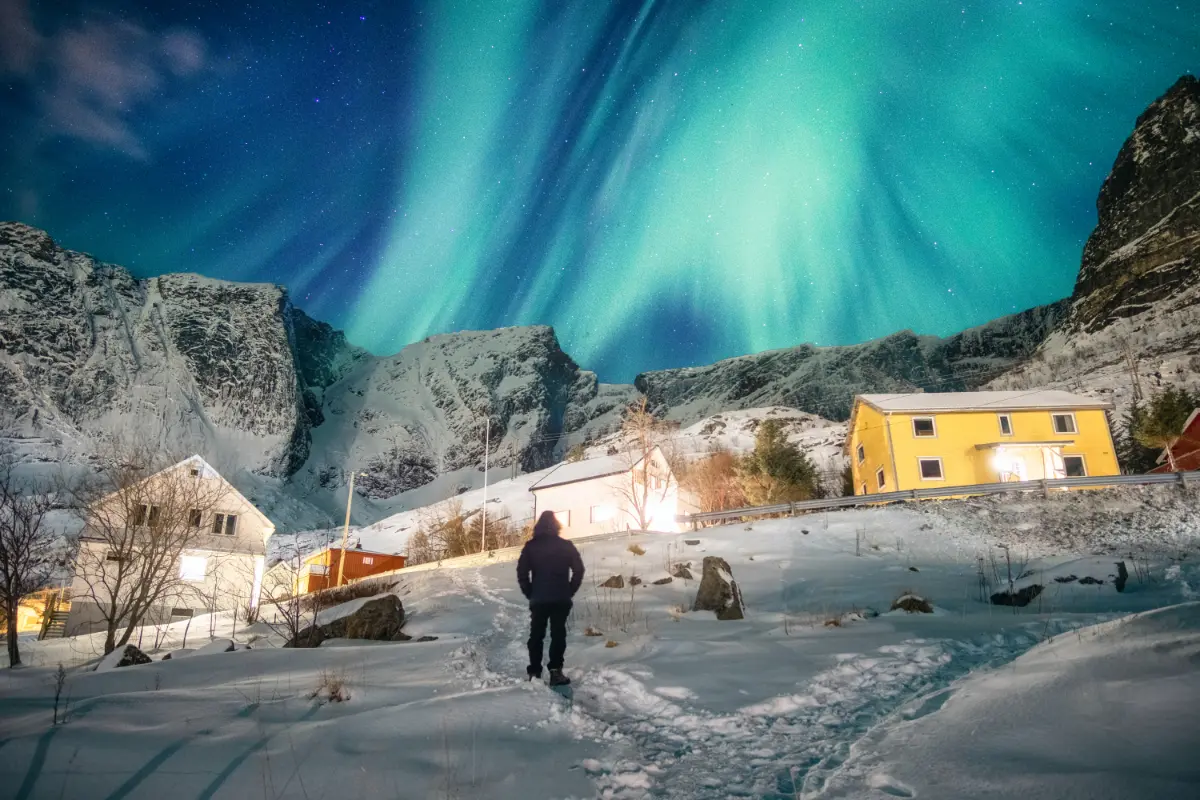
And then, on clear nights, the Northern Lights. Svalbard sits directly beneath the auroral oval — the ring around the magnetic pole within which auroral activity is most concentrated and most intense. Here, the lights are not the faint smudges of pale green that disappoint travellers in less favoured locations. They are violent, structural, chromatic performances — filling the entire sky in movements that seem to respond to music only the sky can hear.
How to Experience Svalbard with The Journey Xpert
Svalbard is one of The Journey Xpert’s specialist destinations — a place we know with the depth that comes from genuine engagement over many years. We design both private cabin-based itineraries from Longyearbyen and small-ship expedition voyages for those who want to penetrate deeper into the archipelago.
We work exclusively with licensed Svalbard guides and expedition operators whose environmental credentials and safety protocols meet the highest international standards. This is a place that demands expertise — in navigation, in wildlife behaviour, in cold-weather safety. We provide that expertise, so that you can focus entirely on absorbing one of the most extraordinary experiences the natural world has to offer. Svalbard, once experienced, leaves a permanent mark. Not just in the photographs, but in the traveller themselves — in a recalibrated sense of what the world is, how old it is, and how rarely we are permitted to see it in its unmediated state. That, more than any itinerary detail, is what The Journey Xpert seeks to give you.